
E-Commerce & Online Retail Insurance
Compare quotes from top-rated carriers.

Trusted by +1M small business owners worldwide
No junk mail. No spam calls. Free quotes.
Buy instantly online
Find your trade
You’ve put real work into building your online store. Protecting it should be the easy part. Whether you sell handmade goods on Etsy, run an Amazon storefront, or manage your own site, we’ll help you understand your coverage options, compare quotes from top carriers, and get covered in minutes — so you can get back to business, knowing you’re protected. Every online business sells a little differently, and your coverage should reflect that. Start with the page that fits how you sell:

Etsy SellerFrom $20.75/month*
Amazon SellerFrom $20.75/month*
E-commerce and Online RetailFrom $20.75/month*
Drop ShippersFrom $20.75/month*

Written by
You’ve put real work into building your online store. Protecting it should be the easy part. Whether you sell handmade goods on Etsy, run an Amazon storefront, or manage your own site, we’ll help you understand your coverage options, compare quotes from top carriers, and get covered in minutes — so you can get back to business, knowing you’re protected.
Find Your Business Type
Every online business sells a little differently, and your coverage should reflect that. Start with the page that fits how you sell:
- Etsy sellers: Coverage for handmade and curated shops, built around Etsy’s seller terms.
- Amazon sellers: Policies that meet Amazon’s Pro Seller insurance requirements, with instant proof of coverage.
- E-commerce and online retail stores: Protection for your independent online storefront from inventory to customer data.
- Dropshippers: Product liability protection, even if you never touch the stock.
What Insurance Does an Online Business Need?
Selling online comes with its own mix of risks — some physical, some digital. These are the four coverages most online retailers consider, so you can build protection that both fits your business and your budget.
Here’s a quick look at which coverage steps in when:
| Insurance type | What’s covered? |
|---|---|
| General Liability | A delivery driver is injured at your home office A competitor claims your ad copied theirs |
| Product Liability | A product you sold injures a customer |
| Cyber Liability | Your customers’ payment data is breached You’re fined after a data privacy violation |
| Commercial Property | Fire or theft wipes out your inventory Your business laptop and equipment are stolen |
A Business Owner’s Policy (BOP) typically combines General Liability, Product Liability, and Commercial Property — plus lost income if a covered event pauses your sales. More on that below.
General Liability insurance (GL) protects your business if a third party alleges that you caused bodily injury, property damage, or personal and advertising injury. For online sellers, that can be a delivery driver tripping over shipping boxes at your home office or a copyright claim over an ad campaign.
Product Liability coverage — typically included with GL — helps protect you if a product you sell causes injury, illness, or property damage. Here’s the part that surprises many sellers: As the “seller of record,” you can be held responsible for a defective product, whether you never made, handled, or stored it. That applies to dropshippers and importers, too. With product liability in place, defense costs don’t have to come from your business.
If your store processes payments or collects customer information, Cyber Liability insurance deserves a close look. Research shows 59% of small- and medium-sized businesses experienced a cyber attack in a single year, and the average cyber claim for a small merchant runs about $205,000. Cyber liability insurance helps cover most costs that typically follow a breach: notifying customers, credit monitoring, forensic investigation, data recovery, legal defense, and regulatory fines — plus lost income while your store is back on its way up.
Your inventory and equipment are the engine of your business. Commercial Property insurance, depending on the coverage of your particular policy, helps protect your stock, packaging supplies, and computer gear from fire, theft, and other covered events at your scheduled business premises. If your inventory is stored at a third-party logistics facility or is frequently in transit, you may need Inland Marine coverage.
A Business Owner’s Policy (BOP) bundles GL and commercial property coverage into one package — usually at a better price than buying each separately. It also typically includes business interruption coverage, which helps replace lost income and keeps up with ongoing expenses if a covered event pauses your sales. For many growing online stores, a BOP is the simplest route to broad protection.
Does Amazon or Etsy Require Sellers to Have Insurance?
Sometimes — and it pays to know the rules before the platform comes asking.
Amazon
If your gross sales on Amazon.com top $10,000 in a single month (or if Amazon requests it), Section 9 of the Amazon Services Business Solutions Agreement gives you 30 days to secure commercial liability insurance1. Amazon typically requires that your policy or policies:
- Provide at least $1 million in coverage per occurrence and in the aggregate, written on an occurrence basis.
- Come from a carrier rated A- or better by AM Best or S&P.
- Name “Amazon.com Services LLC and its affiliates and assignees” as additional insureds.
- Match the legal entity name on your Amazon account, with your deductible listed on your certificate of insurance (COI) — $0 for most sellers or up to $10,000 if your gross sales passed $1 million in the previous 12 months.
Once your policy is active, you will need to upload your COI through Seller Central. A nice bonus: With valid insurance on file, Amazon resolves customer property damage and injury claims up to $1,000 on its own, without coming to you for reimbursement.
1These Amazon rules are current as of the date this article was published.
Etsy
Etsy doesn’t require insurance to open a shop, but its Terms of Use ask sellers to defend and indemnify Etsy — including attorneys’ fees and court costs — if a product, listing, or data issue leads to a claim2. And Etsy’s Purchase Protection Program isn’t insurance: It refunds qualifying orders up to $250 and doesn’t cover liability or injury claims. GL with product liability is how sellers cover that ground themselves.
2This Etsy information is current as of the date this article was published.
Does My Homeowner’s Insurance Cover My Online Business?
Usually not — and this is one of the most common surprises for home-based sellers. Homeowners’ and renters’ policies are built for personal risks, so they typically:
- Cap business property coverage at $1,000 to $2,500 at home, and about $250 for business items away from home — rarely enough to replace real inventory.
- Exclude detached garages, sheds, and workshops used for business, along with everything stored inside them.
- Provide no liability coverage for business activities, such as a courier injured while picking up packages.
The good news: A dedicated business policy closes all three gaps, so your inventory, equipment, and personal finances remain protected. It also can keep you in good standing with your home insurer, since an undisclosed home business can put a homeowner’s policy at risk.
How Much Does E-Commerce Insurance Cost?
For e-commerce and online retailers, prices1 start at $27 per month for general liability and $49 per month for BOP coverage.
| Policy | What It Covers | Median Monthly Cost1 |
|---|---|---|
| General Liability | Costs from third-party accidents, property damage, legal expenses, and bodily injury | $27 |
| Business Owner’s Policy (BOP) | Bundles three key coverages — General Liability, Commercial Property, and Business Interruption insurance | $49 |
1Data from Simply Business customers specializing in the identified trade who purchased at least one or a combination of general liability, or BOP policies from July 1, 2025 to December 31, 2025.
What you’ll pay depends on a few key factors, such as:
- What you sell: Lower-risk products like books and apparel cost usually less to insure than higher-risk categories such as supplements, cosmetics, or battery-powered electronics.
- How much you sell: Higher revenue means more exposure, which underwriters typically price in.
- How you fulfill orders: Warehousing your own stock raises property costs; pure dropshipping keeps them low.
- Your coverage choices: Adjusting limits and deductibles lets you match your protection to your budget.
- Where you’re based and your claims history: State litigation trends and a clean record both affect your rate.
The quickest way to know your price is to get a quote — it takes only a few minutes.
Frequently Asked Questions
E-commerce insurance is a collection of separate business insurance policies designed to protect online retailers from financial losses tied to lawsuits, property damage, cyber incidents, and employee injuries. These include several coverage types rather than a single policy.
For most online sellers, this means pairing General Liability insurance with additional coverages like Equipment and Business Property (Inland Marine) insurance, Cyber Liability, and Workers’ Compensation, depending on the size and structure of the business. Simply Business matches online retailers with customized coverage options from top-rated carriers in as little as ten minutes.
In most cases, yes. Online sellers face product liability claims, cyber risks, and inventory losses — and some marketplaces require coverage. Business insurance helps protect your personal assets, meet platform requirements, and give your customers extra confidence in your shop.
Product Liability is a component of General Liability coverage—it’s not typically a separate policy. General Liability insurance is the broader policy that includes protection against product liability claims, such as a customer being injured by a product you sold.
In other words, if you have General Liability insurance with appropriate limits, you are typically covered for product-related injury claims, without needing to purchase a standalone product liability policy. But you should always review your policy documents to confirm coverage applies.
Inland Marine insurance is generally the better fit for inventory or equipment that moves or is stored offsite, since it’s specifically designed to cover property in transit. Commercial Property insurance, by contrast, typically covers items at a fixed business location.
For e-commerce businesses that ship nationwide or use third-party warehouses, Inland Marine coverage closes a gap that standard Commercial Property policies often don’t address.
If you process payments, collect email addresses, or store customer data, it’s worth serious consideration. Cyber Liability insurance helps cover breach response, forensic investigation, legal defense, and lost income while your systems recover.
Inland Marine insurance, also called Equipment and Business Property coverage, helps financially protect inventory and equipment that’s in transit or stored offsite. This is especially relevant for online retailers who ship products nationwide or store inventory outside a traditional storefront.
Plans start from $20.83/month*, based on the lowest available coverage limit for equipment and small tools policies. This coverage fills a gap that standard commercial property insurance often doesn’t address, since it protects items on the move rather than fixed to one location.
Workers’ Compensation insurance helps cover medical costs and lost wages for employees who get sick or injured on the job. State regulations vary, but most states require small businesses to carry this coverage once they reach a specific threshold of full- or part-time employees.
Plans start from $34.67/month*. Even owner-operators without employees may benefit from this coverage, since it can also protect the business owner in the event of a work-related injury, depending on state requirements.
A BOP combines multiple coverages—typically General Liability and Commercial Property insurance—into a single, bundled policy. It’s designed to simplify coverage for small businesses that need more than one type of protection.
For e-commerce businesses, bundling coverage through a BOP-style approach can streamline management and potentially reduce costs compared to purchasing each policy separately, though the right combination depends on your specific business needs.
Amazon requires Commercial Liability insurance once your gross sales exceed $10,000 in a month, or upon request. Etsy doesn’t require insurance upfront, but its terms require sellers responsible for defending and indemnifying Etsy if a product or listing causes a claim.
Yes, Simply Business offers dedicated insurance resources and coverage options for sellers on major marketplaces, including Amazon and Etsy. Coverage needs can vary depending on marketplace requirements and whether you use third-party fulfillment.
Marketplace platforms often have their own insurance requirements for sellers, so it’s worth reviewing platform-specific policies (such as Amazon’s seller insurance requirements) alongside your general business coverage.
General Liability insurance helps cover costs from third-party accidents, property damage, and bodily injury claims—including product liability claims where a customer is injured by a product you sold. It’s considered a foundational coverage for e-commerce businesses.
It applies even if your store has no physical location, since claims can still arise from products reaching customers.
Coverage limits typically range from $100K to $2M, though limits may vary by state and the nature of your business.
General Liability policies start from $21.58/month* through Simply Business.
Online retailers need General Liability insurance because liability risks extend beyond a physical location. A customer can still be injured by a product you sold, or your business could face a property damage claim, even without foot traffic through a storefront.
Product liability claims—where a shipped item causes injury or damage—are one of the most common risks e-commerce sellers face, making this coverage relevant regardless of whether you operate from a warehouse, home office, or fulfillment center.
Typically, no. Homeowners’ policies cap business property at $1,000 to $2,500 and exclude business liability. A commercial policy is the reliable way to protect your inventory and equipment.
Yes. As the seller of record, dropshippers can be held responsible for defective products under U.S. law, even without ever handling the inventory. Product liability coverage can help cover defense costs and settlements, mitigating your financial risk.
Without insurance, your business would be responsible for covering legal defense costs, settlements, or judgments entirely out of pocket. For a small e-commerce business, a single lawsuit—even one tied to a defective product you didn’t manufacture—can be financially devastating.
General Liability insurance is specifically designed to help absorb these costs, covering legal fees and damages for covered claims up to your policy’s coverage limit so a single claim doesn’t threaten your business’s survival.
Pricing varies based on your specific business, but Simply Business displays starting monthly estimates for reference: General Liability from $21.58/month*, Equipment and Business Property from $21.00/month*, and Workers’ Compensation from $38.91/month*.
These figures are calculated from the 10th percentile of relevant policies sold between July and December 2025. Your final price depends on your state, selected carrier, and specific business details, and may include an initial down payment.
You can get quotes by completing one online application, which Simply Business uses to shop coverage from multiple leading carriers on your behalf. The entire process, from application to quotes, typically takes less than ten minutes.
Once you review your options, you can buy a policy instantly online and receive proof of insurance without needing to speak with multiple providers separately.
Yes, Simply Business is a licensed insurance agent that helps small businesses compare and purchase coverage from a range of top-rated carriers. Rather than underwriting policies itself, Simply Business matches your business with policy options from its carrier network based on the details you provide.
You complete one application, receive multiple customized quotes, and can buy coverage instantly online—all typically within about ten minutes.
Yes, Simply Business partners with a network of highly rated carriers, including well-known names like Travelers, Liberty Mutual, Hiscox, and Markel. This network allows the company to match online retailers with coverage options tailored to their specific risks and budget.
Simply Business has served more than one million customers worldwide and covers over 400 business types, including e-commerce and online retail.
*The displayed price for policy purchased is a monthly estimate calculated from the 10th percentile of relevant policies sold by Simply Business. This estimate uses data from relevant policy (i.e. General Liability, Inland Marine, Workers’ Compensation or Equipment and Business Property Insurance) sales between July–December 2025. Final price and payment terms, which may include an initial down payment, are subject to change based on your state, selected insurance provider, and specific business details.
Written by
Why Small Businesses Choose Simply Business
Small business insurance is what we do. Whether it’s covering you for accidents and errors, meeting workers’ comp requirements, or financially protecting your business from the unexpected, we can help find the coverage you need for your business.

Start your quote
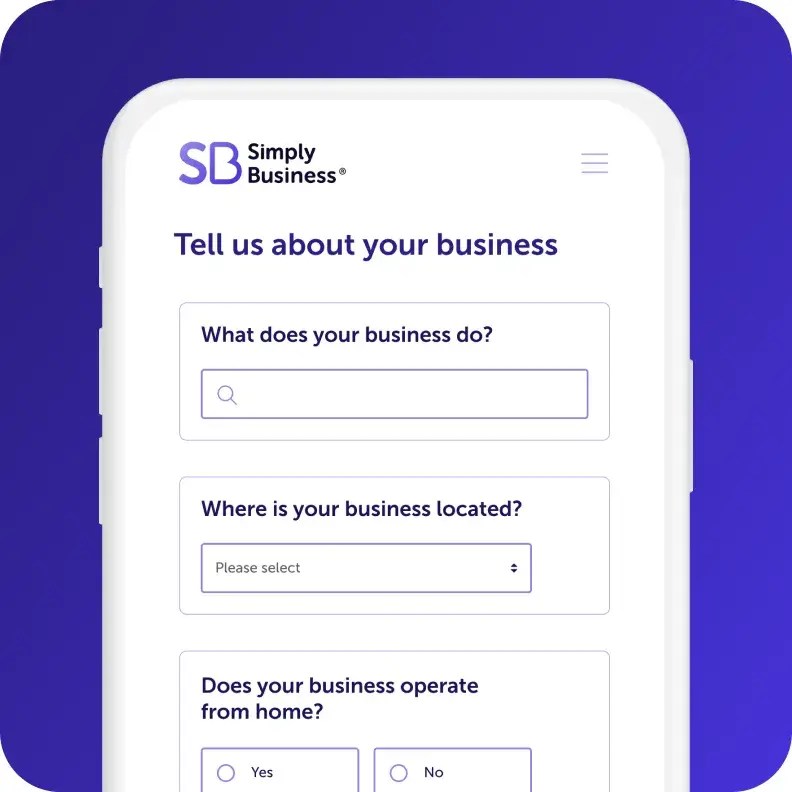
Answer a few questions about
your business in one form.

Review quotes
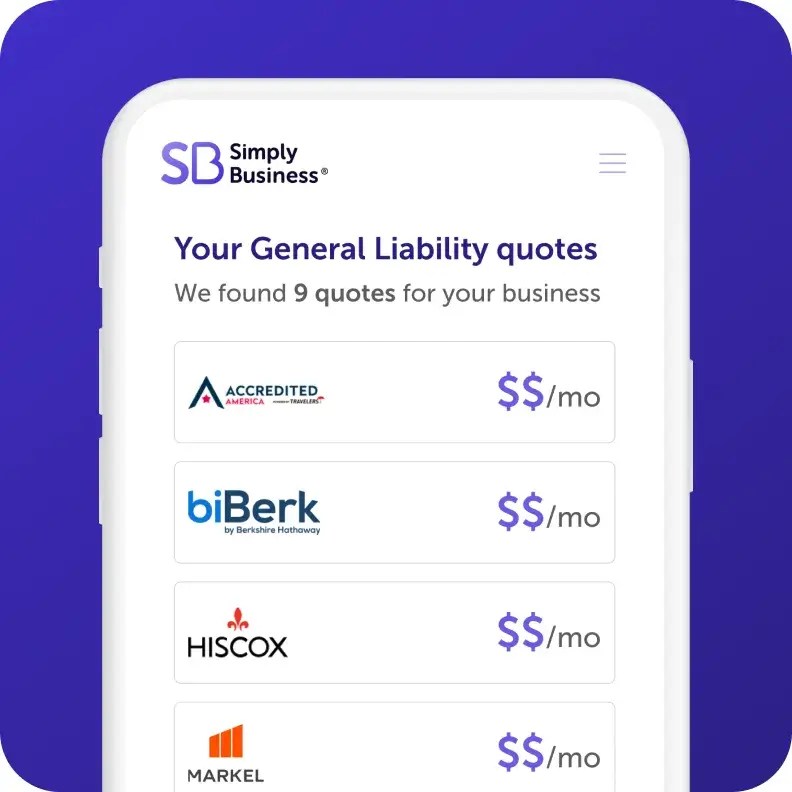
Compare quotes side by side from top-rated insurers and customize your coverage.

Get protected in minutes
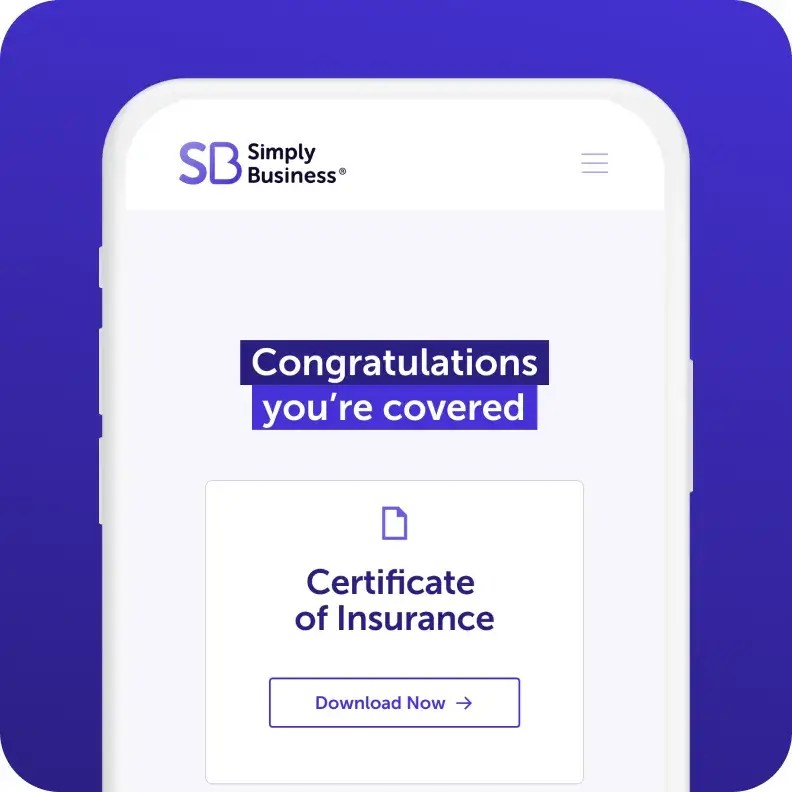
Purchase your policy, and get instant proof of insurance – all online, and all within 10 minutes.
Our +1 million customers worldwide are big fans. And you will be too.

The process was smooth and easy to complete. I was able to obtain business insurance quickly to meet my marketplace requirements. The online experience was clear and user-friendly.

Don S.
E-commerce/online retailer, Wyoming
With Simply Business I know I can look at different carriers, but also see all my stuff in the same place… a lot of [insurance] providers don’t offer a variety of coverage, all in one place.

Jef
Owner of Bunker83 LLC
Fast, good service and a reasonable price for the coverage.
Derek M.
E-commerce/online retailer, California
Feel confident in your choice.
We partner with a range of top-rated carriers and use smart technology to match you with policies that fit your specific business, your risks, and budget.

400+
business types covered

1M+
customers worldwide

18
top-rated carriers
















We’ve Got More Helpful Information
4-minute read
Amazon Seller Business Insurance: What You Need to Know

5-minute read
6 Biggest Benefits of Ecommerce Business Insurance

*The displayed price for each product is a monthly estimate calculated from the 10th percentile of relevant policies sold by Simply Business (e.g., General Liability data is used for General Liability estimates). This estimate uses data from relevant policy sales between July–December 2025. Final price and payment terms, which may include an initial down payment, are subject to change based on your state, selected insurance provider, and specific business details.
† Limits may vary by state and nature of your business.
‡ Displayed price is based on the lowest available coverage limit for Equipment and Small Tools policies.
Page last updated: